Note
This page was generated from a Jupyter notebook.
Download: pole_figure.ipynb
Pole figure notebook example#
[ ]:
import numpy as np
from matplotlib.colors import LogNorm

import cdiutils

cdiutils.plot.update_plot_params()
Path to the data that contains the orhtogonalised Bragg peak, along with the corresponding grid of q values.
If you have run the BcdiPipeline.preprocess() function, you can find the data in the results folder, in the "S<scan>_preprocessed_data.cxi" file.
[ ]:
path = "path/to/data.cxi"
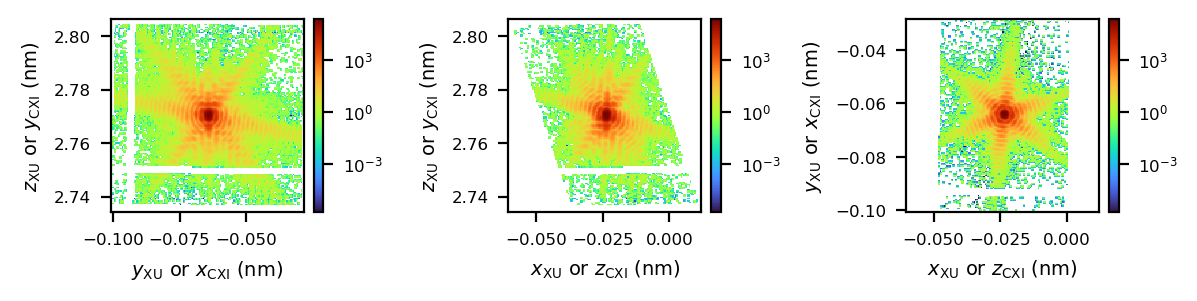
Load and plot the data
[3]:
with cdiutils.CXIFile(path, "r") as cxi:
    data = cxi["entry_1/data_2/data"]
    qx = cxi["entry_1/result_2/qx_xu"]
    qy = cxi["entry_1/result_2/qy_xu"]
    qz = cxi["entry_1/result_2/qz_xu"]
    shift = cxi["entry_1/result_2/q_space_shift"]

print(qx.shape, qy.shape, qz.shape, data.shape)
voxel_size = (np.diff(qx).mean(), np.diff(qy).mean(), np.diff(qz).mean())

fig, axes = cdiutils.plot.plot_volume_slices(
    data,
    voxel_size=voxel_size,
    data_centre=shift,
    norm=LogNorm(),
    convention="xu",
    show=False,
)

cdiutils.plot.add_labels(axes, convention="xu")
fig
(141,) (146,) (146,) (141, 146, 146)
[3]:
Usage of cdiutils.analysis.pole_figure#
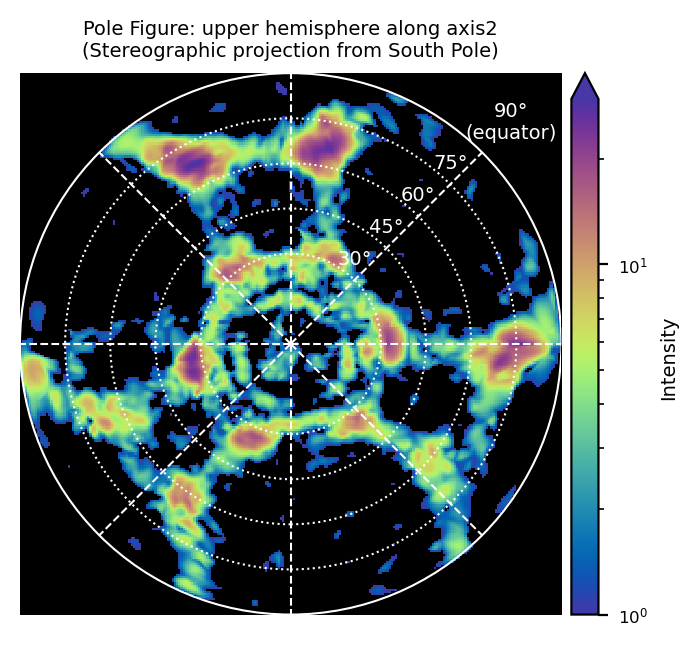
The cdiutils.analysis.pole_figure function generates a crystallographic pole figure using stereographic projection. This method maps 3D diffraction intensity data onto a 2D plane, providing a visual representation of the crystallographic orientation distribution.
Parameters:#
intensity (np.ndarray): A 3D array of intensity values representing the diffraction data.
grid (list): A list of 1D arrays defining the orthogonal grid (e.g.,
[x_coords, y_coords, z_coords]).axis (str, optional): Specifies the projection axis and hemisphere:
"0","1","2": Upper hemisphere projection onto the equatorial plane."-0","-1","-2": Lower hemisphere projection onto the equatorial plane.The absolute value of the axis determines the normal plane:
|axis|=0: Project onto the yz-plane (normal to x-axis).|axis|=1: Project onto the xz-plane (normal to y-axis).|axis|=2: Project onto the xy-plane (normal to z-axis).
Defaults to
"2"(upper hemisphere projection onto the xy-plane).
radius (float, optional): Radius of the spherical shell for data selection. Defaults to
None(0.25 * max radial distance).dr (float, optional): Thickness of the spherical shell. Defaults to
None(0.01 * radius).resolution (int, optional): Resolution of the output 2D grid (number of points per dimension). Defaults to
250.figsize (tuple, optional): Size of the output figure. Defaults to
(4, 4).title (str, optional): Title for the plot. Defaults to
None.verbose (bool, optional): If
True, prints and plots additional information. Defaults toFalse.save (str, optional): File path to save the plot. Defaults to
None.plot_params (dict, optional): Additional parameters for the plotting function.
Returns:#
tuple:
(grid_x, grid_y, projected_intensity): The 2D grid coordinates and intensity values.(fig, ax): The figure and axis objects for the plot.
[ ]:
# Basic usage with default parameters
(grid_x, grid_y, projected_int), (fig, ax) = cdiutils.analysis.pole_figure(
    data,
    [qx, qy, qz],
    radius=0.020,
    dr=0.0002,
    axis="2",
    norm=LogNorm(
        1,
    ),
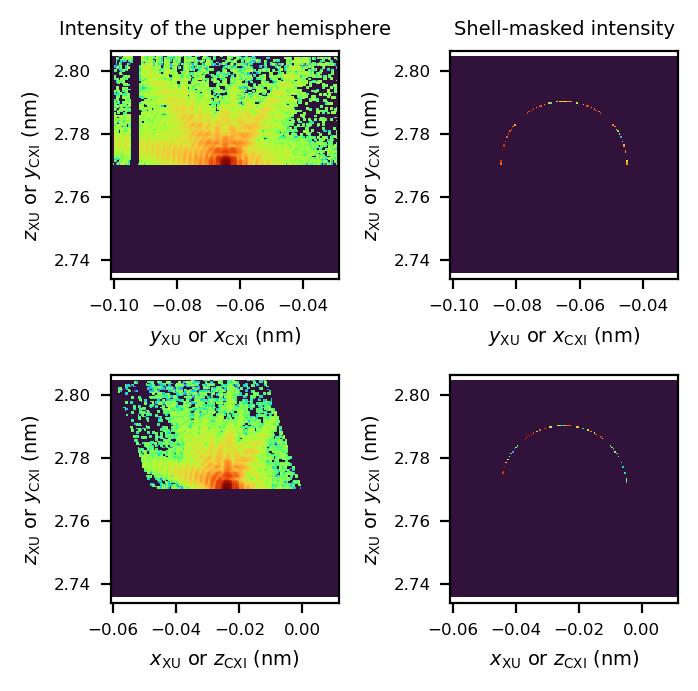
    verbose=True,
)
Projection axis: 2, selecting upper hemisphere with observer at South Pole
Selected radius: 0.020 and spherical shell thickness: 0.00020